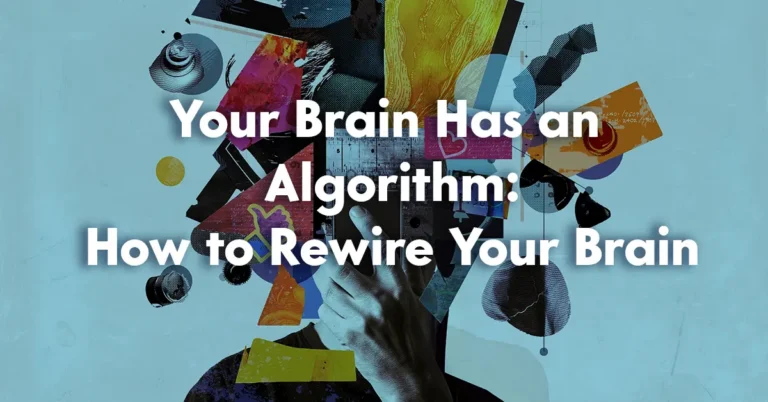
Your Brain Has an Algorithm: How to Rewire Your Brain
Your Brain Has an Algorithm: How to Rewire Your Brain
Your Brain Has an Algorithm: How to Rewire Your Brain
Learning how to rewire your brain starts with noticing what you give your attention to every day.
If you’ve spent any time online, you know how quickly the algorithm learns you.
Watch one cat video, and now you couldn’t stop them if you tried. Click on an ad? You’ll get 10 more just like it.
Technology is developed to give you more of what you engage with.
Your brain works the same way. It is designed to give you more of what you think, feel, and focus on.
Your brain and nervous system are constantly taking notes:
What you pay attention to.
What you react to.
What you replay.
Your brain gets faster at finding more of it.
If you spend your time scanning for what’s wrong, your brain becomes efficient at spotting problems. If you rehearse frustration, it strengthens that emotional pathway. If you focus on what’s missing, you’ll default to a place of lack.
Remember, your brain isn’t trying to make you happy. It’s only trying to keep you safe and efficient, so what you repeat gets reinforced.
The good news is that you can change the algorithm of your brain. How, you ask?
Catch it. Check it. Choose it.
1. Catch it: Notice what you’re thinking, feeling, and focused on.

This is the hardest step because you can’t change what you don’t notice. Most of our reactions are fast, automatic, and familiar. Your brain is designed for efficiency, so it runs well-worn patterns on default.
You don’t wake up and think, “Today I’d like to overthink that email, assume the worst, and carry it with me for the next six hours.” And yet… here we are.
Catching it means noticing:
What you’re thinking (“Why would they say that?”)
What you’re feeling (annoyed, anxious, defensive)
What you’re focusing on (the co-worker with the annoying laugh.)
This isn’t about judging yourself or fixing it. It’s about awareness.
A simple way to practice is to tie this check-in to something you already do several times a day (go to the bathroom, wash your hands, drink a glass of water, etc.)
What am I feeling and focusing on?
How is it affecting how I’m showing up?
How do I want to show up instead?
Once you see the pattern, you can decide if it’s serving you.
2. Check It: Is this useful or just familiar?

Thoughts and feelings are not facts. And not everything that’s loud in your mind deserves your attention.
After you catch it, ask yourself:
Is this helping me… or just something I’ve practiced a lot?
Is this a fact… or a story I’m telling myself?
Is this worth my energy right now?
Here’s the tricky part: your brain prefers what’s familiar over what’s helpful. If you’ve practiced worry, frustration, or worst-case thinking, those patterns feel natural—even when they’re not serving you.
Checking it doesn’t mean you ignore problems or force positivity. It means you decide whether this particular thought or reaction is worth continuing. Sometimes the answer is yes. Often, it’s just habit.
3. Choose It: Decide what gets your attention

This is where your power is.
You may not control the first thought.
You may not control the first emotional reaction.
But you have far more influence over what happens next than you think.
Choosing it means asking:
Do I want to give this more attention?
Whatever you keep feeding grows stronger.
The more you replay a frustration, the more it sticks.
The more you focus on what’s wrong, the more your brain finds it.
The more you engage with something, the more it becomes your default.
Choosing doesn’t mean pretending everything is fine.
It means redirecting your attention toward something more useful, more intentional, or more aligned with how you want to show up.
Sometimes that looks like:
- Letting a thought pass instead of chasing it.
- Shifting your focus to what’s within your control.
- Taking a breath before responding.
- Asking a better question.
Small choices, repeated over time, create very different patterns.
Why This Matters
Your brain and nervous system are constantly learning from you.
Every thought you rehearse, every emotion you dwell on, every pattern you repeat—you’re teaching it what to prioritize.
You’re training your “algorithm.” Not all at once. But moment by moment.
The good news? You don’t have to overhaul everything.
You just have to catch one moment.
Check one thought.
Choose one response.

Pause & Ponder
What have I been giving the most attention to lately?
Is it creating more of what I want?
More Blogs to Read:
SIGN UP FOR ANNE'S WEEKLY RESILIENCE RESET NEWSLETTER!

MORE RECENT BLOG POSTS




ANNE’S BOOKS